
Does shockwave add anything to Achilles tendinopathy rehab?
Meta-analyses of sham-controlled trials found no significant differences between ESWT and sham for pain or function in chronic Achilles tendinopathy, while a network meta-analysis ranked ESWT second among conservative treatments for pain in Achilles tendinopathy, and its pairwise analysis found a significant benefit over placebo. A trial pairing shockwave with progressive resistance training showed both groups improve, with tendon micromorphological remodelling appearing more pronounced in the combined group.
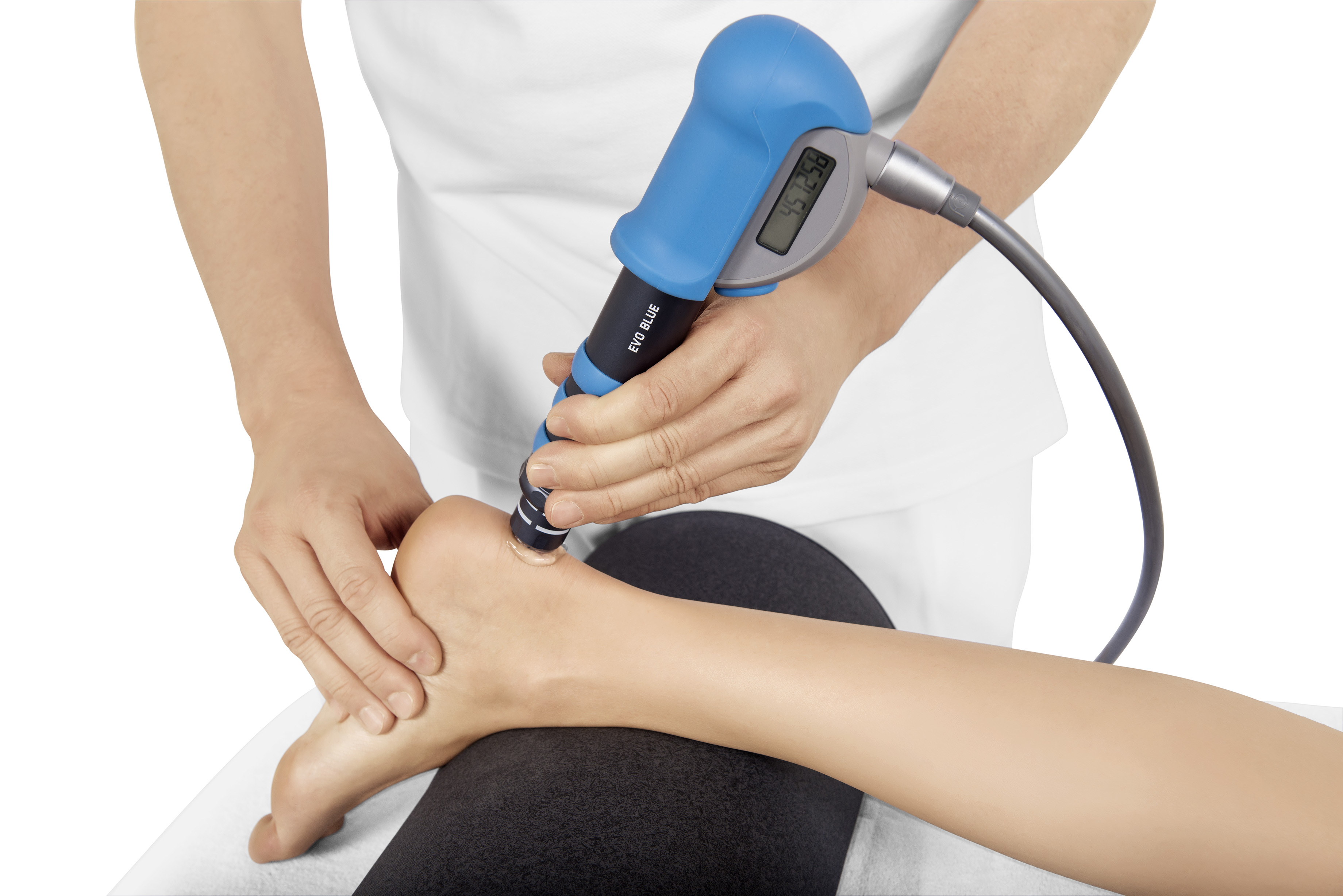
Shockwave keeps coming up in Achilles tendinopathy conversations — sometimes as the thing you offer when loading has stalled, sometimes as the thing the patient asks for by name. The question worth asking is narrower: does extracorporeal shockwave therapy (ESWT) actually add anything over sham or over the loading programmes you are already prescribing? Several 2026 syntheses and trials speak directly to that, and the answers are less tidy than the marketing suggests.
Against sham, the signal is weak
Korakakis et al. (2026) systematically reviewed randomised trials comparing SWT against sham-SWT, control or no treatment in adults with insertional and mid-portion Achilles tendinopathy (n=557). For insertional Achilles tendinopathy, SWT showed no clinically meaningful benefit over sham, with consistent findings across all outcomes and sensitivity and subgroup analyses, at low-to-moderate certainty. For mid-portion disease, all meta-analyses showed no significant differences in disability or pain between SWT and control interventions at any timepoint. The main positive read was very low-certainty evidence of a clinically meaningful effect of radial SWT on short- and long-term disability and pain versus sham or wait-and-see controls. The authors themselves flag that most effect estimates rest on very low- and low-certainty data, so the true effects may change with future high-quality trials.
Ni et al. (2026) ran a meta-analysis restricted to chronic Achilles tendinopathy, pooling 458 participants from eight RCTs in ESWT-versus-sham comparisons. No significant differences were observed between ESWT and sham in pain (ΔVAS) or function (ΔVISA-A, ΔAOFAS) across follow-ups, all P > 0.05. Adverse events were numerically higher with ESWT (4.5% vs. 1.2%), though the difference was non-significant (P = 0.12).
One subgroup result worth reading carefully
The same meta-analysis did find one positive slice: in a subgroup analysis, ESWT led to significant VAS reduction versus sham in patients with symptom duration under 12 months, at one month (WMD −0.76, P = 0.03) and three months (WMD −1.23, P = 0.001). That is a genuine finding, but read it for what it is — a subgroup analysis in a meta-analysis whose overall result was null, from authors who state that more high-quality evidence is needed. It is a hypothesis about earlier-stage disease, not a treatment indication.
Where the favourable rankings come from
If shockwave looks worse against sham but keeps getting recommended, part of the answer lies in how the comparisons are framed. Guo et al. (2026) ran a network meta-analysis across 3,921 patients with various tendinopathies, including Achilles. In a pairwise subgroup analysis for Achilles tendinopathy, ESWT beat placebo for VAS (SMD −0.49, 95% CI −0.83 to −0.16, I² = 0), and ESWT ranked second in SUCRA for improving VAS, with a significant difference from the first-ranked treatment (MD 2.55, 95% CI 1.86–3.24). The authors' headline is that compared to other conservative treatments, ESWT holds a favourable position in lateral epicondylitis, Achilles tendinopathy and rotator cuff tendinopathy. Note what the network cannot do: ranking second behind another conservative treatment (abbreviated LT in the abstract) is not the same as adding value on top of loading.
The loading baseline is not trivial
Any add-on question depends on what the base treatment achieves on its own. Janssen et al. (2026) randomised adults with chronic mid-portion Achilles tendinopathy to calf eccentric exercise (EET) or upper-limb strength training (UET) as unsupervised home programmes, measuring VISA-A at 12 weeks. Both groups improved — a mean VISA-A gain of 10 points (95% CI 2–22) with EET and 6 points (95% CI 2–15) with UET — and the adjusted between-group difference was not significant (4 points; 95% CI −7 to 15). The authors' own conclusion is blunt: these findings suggest limited short-term effectiveness of EET as an unsupervised home-based exercise programme. In a related population, Yuan et al. (2026) reviewed eccentric exercise against other conservative therapies in Achilles tendinopathy (n=994) and found superior pain reduction for eccentric work versus physical modalities (VAS SMD −0.54; NRS SMD −0.29), alongside ultrasound improvements in tendon structure — increased AP thickness (SMD 0.41) and reduced vascularity — while noting that functional outcomes (VISA-A) showed smaller improvements with eccentric exercise than with controls, with extremely high heterogeneity (I² = 86.1%) precluding definitive conclusions.
Combined protocols: one small trial, one interesting tendon
The most direct test of 'does shockwave add to loading' is Katolický et al. (2026), an RCT in 41 participants with chronic unilateral mid-portion Achilles tendinopathy comparing resistance training alone against resistance training plus focused shockwave, with measurements at baseline and weeks 6, 12 and 26. Both groups showed significant pain reduction and functional improvement (p < 0.001). The structural story is where the groups diverged: cross-sectional area decreased significantly only at week 26 in the combined group (p = 0.031), and spatial frequency analysis showed time-dependent micromorphological remodelling — decreased P6 and SUM, increased PPP and Q6 — consistent with improved collagen organisation and tissue homogeneity, a pattern that appeared more pronounced in the combined group. That is a promising mechanistic signal in a 41-patient trial, not proof of a clinical add-on: the clinical outcomes improved in both arms.
What this means in your clinic
A reasonable reading of this body of evidence:
1 |
Treat shockwave as unproven against sham in chronic Achilles tendinopathy, insertional and mid-portion alike — that is what the two sham-controlled syntheses show. If you use it, say so honestly to the patient. |
2 |
Do not sell it as an add-on to loading on current evidence. The combined-protocol trial shows both arms improving clinically, with micromorphological remodelling appearing more pronounced with shockwave — worth watching, not yet practice-changing. |
3 |
Keep loading as the backbone, and take the Janssen finding seriously: unsupervised home eccentric programmes showed limited short-term effectiveness, with no significant between-group difference versus an unrelated upper-limb exercise programme. That trial did not test supervised programmes, so whether supervision and progression make the difference remains open. |
4 |
If you reach for shockwave at all, the only subgroup signal is early disease — symptoms under 12 months — and even that comes with the authors' call for better trials. |
None of this says shockwave is useless; it says the sham-controlled evidence does not currently support it as a meaningful addition to a well-run loading programme. Before escalating stubborn cases, a reasonable step is to verify that the loading plan is actually being followed, since a loading plan that is not being followed cannot be fairly judged.
Since a loading programme that is actually followed remains the base, PhysioSync's Home Programs and Smart Alerts show whether the plan is being done between visits, so you can judge a stalled case fairly before escalating.
References
- Guo NY, Wang SQ, Liu W et al. The Effect of Extracorporeal Shockwave Therapy in Tendinopathy: A Systematic Review and Network Meta-Analysis of Randomized Controlled Trials. Orthopaedic surgery (2026) · PMID 42733276
- Yuan F, Ren K, Zhao Z et al. The efficacy of eccentric exercise in the treatment of Achilles tendinopathy: a systematic review and meta-analysis. BMC musculoskeletal disorders (2026) · PMID 42021217
- Korakakis V, Kotsifaki R, Sotiralis Y et al. Shockwave Therapy for Midportion and Insertional Achilles Tendinopathy: A Nail in the Coffin? A Systematic Review With Meta-Analysis. The Journal of orthopaedic and sports physical therapy (2026) · PMID 42063301
- Ni T, Zhao Y, Pang L et al. Extracorporeal shockwave therapy versus sham extracorporeal shockwave therapy for chronic Achilles tendinopathy: a meta-analysis of randomized controlled trials. PeerJ (2026) · PMID 41522497
- Katolický J, Nedělka T, Bashford G et al. Ultrasound-based evaluation of changes in tendon macro- and micromorphology following exercise and ESWT in mid-portion Achilles tendinopathy: A randomized clinical trial with a 26-week follow-up. Journal of science and medicine in sport (2026) · PMID 42120288
- Janssen T, van Berkel S, Edens M et al. Effectiveness of eccentric calf muscle exercise therapy in patients with chronic midportion Achilles tendinopathy: a randomized controlled trial. Journal of science and medicine in sport (2026) · PMID 42575766